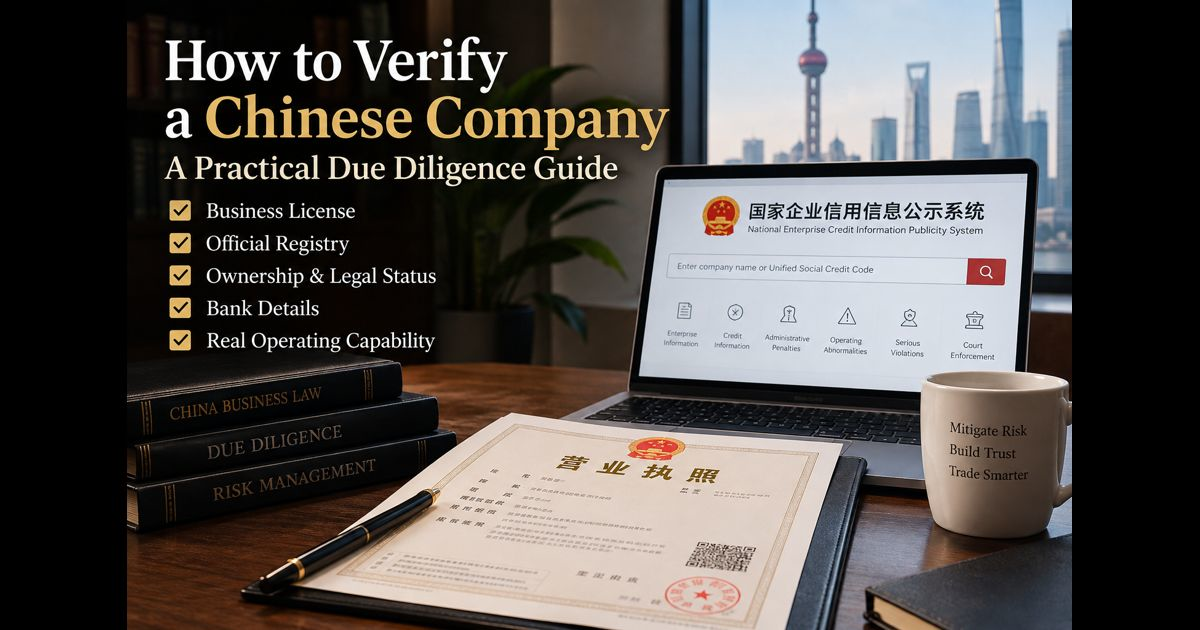
To verify a Chinese company, obtain its full registered legal name and Unified Social Credit Code, then compare its business license with the official National Enterprise Credit Information Publicity System. After confirming that the entity exists and remains active, examine its legal representative, registered address, business scope, shareholders, regulatory history, court enforcement records, payment details, and actual operating capability.
A successful registry search proves that a legal entity is registered. It does not prove that the company is financially stable, owns a factory, will deliver suitable products, or can be trusted with a large payment. Effective verification therefore combines official records with commercial due diligence.
Start With the Correct Jurisdiction
This guide covers companies registered in mainland China. Hong Kong, Macao, and Taiwan maintain separate company-registration systems and should not be searched through mainland China’s enterprise registry.
This distinction matters because mainland China, Hong Kong, Macao, and Taiwan operate under different legal systems. A Hong Kong certificate of incorporation, for example, does not prove that the same business has a registered company or manufacturing facility in mainland China.
Before beginning a search, confirm where the proposed contracting party is registered. Do not rely on a website address, telephone number, warehouse location, salesperson’s location, or marketplace profile to identify the legal entity.
Information to Request From the Company
Ask the company to provide the following information before discussing a deposit or signing a significant agreement:
- A clear and complete copy of its business license
- Its full registered legal name
- Its Unified Social Credit Code
- Its registered address
- The name of its legal representative
- The address of its actual factory or operating location
- Its bank beneficiary name and account details
- Any industry-specific permits relevant to the transaction
- The name of the entity that will sign the contract
- The name of the entity that will issue invoices
- An explanation of any related trading, manufacturing, or payment company
The registered legal name is particularly important. A company may use an English trading name in emails, packaging, exhibitions, online marketplaces, or international transactions, but that name may not be its officially registered identity.
If a supplier provides only a trading name and refuses to disclose its registered legal name or business license, the company cannot be verified reliably.
Understand the Chinese Business License
A business license records the official identity and basic registration details of a company. It normally contains several important fields.
|
Business license field |
What it means |
What to examine |
|
Unified Social Credit Code |
The company’s unique registration identifier |
Confirm that the complete 18-character code matches the official registry |
|
Company name |
The officially registered legal name |
Use the complete registered name in searches and contracts |
|
Entity type |
The company’s legal structure |
Identify whether it is a limited company, partnership, individual business, or another structure |
|
Legal representative |
The person formally registered to represent the company |
Compare the name with registry records and signing documents |
|
Registered capital |
The amount shareholders have committed to contribute |
Do not treat it as proof of available cash or financial strength |
|
Establishment date |
The date on which the entity was registered |
Compare it with claims about the company’s operating history |
|
Registered address |
The official address recorded with the registration authority |
Distinguish it from the company’s office, warehouse, or factory |
|
Business scope |
The activities the company is registered to conduct |
Check whether they reasonably relate to the proposed transaction |
|
Registration authority |
The authority responsible for the registration |
Confirm that the record appears in the appropriate official system |
|
Business term |
The permitted operating period where one is stated |
Confirm that the operating term has not expired |
Request a clear color copy of the entire license. Cropped images, blurred fields, missing sections, inconsistent fonts, altered text, or documents assembled from several images require further investigation.
A professional-looking document alone is not enough. Every important detail should match the official public record.
Search the Official Chinese Enterprise Registry
The National Enterprise Credit Information Publicity System, commonly known as GSXT, is the primary public platform for checking company-registration information in mainland China. It operates under the country’s market-regulation authorities.
Search using either:
- The company’s complete registered legal name; or
- Its 18-character Unified Social Credit Code.
The Unified Social Credit Code is generally the more precise search identifier. Different companies may have similar trading names, while translation and spelling differences make English-name searches unreliable.
The official system is primarily designed for domestic users and may present language barriers, captchas, access restrictions, or technical difficulties. Browser translation may help with navigation, but names, codes, dates, status descriptions, and other important fields should be checked carefully.
Commercial databases may present the information in a more accessible format. However, they should not replace the underlying official record. A company check is only dependable when important claims can be traced to an appropriate source, which is also essential when researching and verifying legal information online.
Match the Registry Record With the Business License
Finding a company in the official registry is only the beginning. Compare each important field with the business license and other documents supplied by the company.
At minimum, confirm that:
- The registered legal name matches
- The Unified Social Credit Code matches
- The company has not been deregistered
- The business license has not been revoked
- The legal representative is consistent
- The registered address is consistent
- The establishment date is consistent
- The entity type is consistent
- The registered capital is consistent
- The business scope reasonably relates to the proposed activity
- Any recent material changes have been explained
Minor formatting differences may result from translations or document layouts. Differences involving the company name, registration code, operating status, legal representative, or contracting entity are more serious.
Save a dated copy or screenshot of the registry record. Company information can change, and maintaining a clear record helps establish what was checked before the transaction.
Interpret the Company’s Operating Status Carefully
The official registry may describe a company’s status in several ways.
|
Status |
General meaning |
Appropriate response |
|
Active or operating |
The entity continues to exist in the registry |
Proceed with the remaining verification checks |
|
Open for business |
The entity is registered as operating |
Continue with commercial and operational due diligence |
|
Deregistered |
The company has completed or entered a termination process |
Do not contract or pay without identifying a different valid entity |
|
License revoked |
The registration authority has revoked the business license |
Treat this as a serious warning requiring professional investigation |
|
Abnormal operations |
A filing, address, reporting, or compliance issue has been recorded |
Investigate the reason and determine whether it was corrected |
|
Registration transferred |
The record has moved to another registration authority |
Locate and review the current registration record |
An active status does not mean the company has no debts, disputes, penalties, or operating problems. It only confirms that the registry currently recognizes the entity as existing or operating.
An abnormal-operations entry is not automatically proof of fraud. It can result from a missed filing, an inaccurate registered address, or another compliance problem. The reason, seriousness, duration, and correction history should be examined.
Review Annual Filings and Registration Changes
Where available, examine the company’s annual reports and change history. These records may reveal:
- Changes in shareholders
- Changes in the legal representative
- Changes in registered capital
- Changes in the registered address
- Changes in business scope
- Previous company names
- Reported contact information
- Equity pledges
- Ownership restructuring
- Other disclosed corporate changes
Frequent changes are not automatically improper. However, a recent change in ownership, legal representative, address, company name, or registered capital shortly before a major transaction deserves an explanation.
Annual information may be submitted by the company itself and may not constitute an independent audit. Use it as a comparison point rather than assuming every field has been independently verified.
Do Not Treat Registered Capital as Available Cash
Registered capital is often misunderstood during company verification. It generally reflects the amount shareholders have committed to contribute under the company’s corporate arrangements.
It does not necessarily show:
- How much money is currently held by the company
- Whether the company is profitable
- Whether all capital has already been contributed
- Whether the company can pay its debts
- Whether it owns significant equipment or property
- Whether it can complete a particular order
- Whether it has reliable cash flow
A large registered-capital figure should not be used as the sole measure of financial strength. Compare it with the company’s age, ownership, operating scale, transaction value, available financial information, and requested payment terms.
A relatively small registered-capital figure does not automatically make a company illegitimate. It may, however, affect how much advance payment or unsecured credit a buyer is willing to risk.
Examine the Business Scope Without Overreading It
The registered business scope describes the activities the company is authorized or registered to conduct. It can help determine whether a supposed manufacturer appears to operate in a relevant industry.
For example, a business scope limited to consulting or general trading would not support a claim that the company owns and operates a specialized manufacturing facility. However, business-scope descriptions can be broad, standardized, incomplete, or difficult to translate accurately.
Use the business scope as a risk indicator, not as conclusive proof of capability.
If manufacturing ability matters, supplement the registry check with:
- A verified factory address
- A live video walkthrough
- Production-line evidence
- Machinery and capacity information
- Quality-control records
- Product samples
- A third-party factory audit
- Evidence showing who owns or leases the facility
- Relevant environmental, safety, and industry permits
A registered company can still be a trading company, intermediary, sourcing agent, sales office, or export affiliate rather than the factory that will manufacture the goods.
Confirm Who Owns and Controls the Company
Review available shareholder, executive, and ownership information where the size or nature of the transaction justifies it.
The objective is to determine:
- Who owns the contracting company
- Whether it belongs to a larger corporate group
- Whether the claimed factory is owned by a related entity
- Whether the payment recipient is connected to the contracting party
- Whether a recently registered company is using another company’s history
- Whether the salesperson has authority to represent the entity
- Whether major ownership changes have occurred recently
Corporate groups may use different entities for manufacturing, exporting, invoicing, intellectual-property ownership, and payment collection. That structure is not necessarily improper, but each company’s role should be documented.
If one company negotiates the order, another signs the contract, a third manufactures the goods, and a fourth receives payment, the buyer needs a clear explanation of how those entities are connected and which entity is responsible if the transaction fails.
Verify the Legal Representative and Signing Authority
The legal representative shown in the registry has a formal role in representing the company. However, many contracts are signed or managed by employees, directors, or other authorised agents.
Before signing an agreement, confirm that:
- The contract identifies the correct registered company
- The registered legal name is accurate
- The Unified Social Credit Code is included where appropriate
- The signatory’s name and position are stated
- The signatory has authority to act for the company
- The company chop is applied where required or expected
- The chop belongs to the contracting entity
- The signature does not belong to an unrelated company or individual
A company email address, online marketplace account, business card, or job title does not independently prove signing authority.
For a significant transaction, request written authorization if the signatory is not the registered legal representative or another person whose authority has been established.
Company chops require particular attention because control of an authorized company chop can have important practical and legal consequences. A convincing red stamp should not be accepted without checking the entity name and execution arrangements.
Match the Contracting Entity With the Bank Beneficiary
Payment verification is one of the most important stages of company due diligence. Many losses occur even after the correct company has been identified because funds are sent to an unrelated or compromised account.
Compare the bank beneficiary with:
- The company name on the business license
- The contracting party named in the agreement
- The entity issuing the commercial invoice
- The entity identified in the purchase order
- Any related company disclosed during negotiations
A mismatch does not always prove fraud. Exporters may use affiliated trading companies, authorized collection arrangements, or legitimate cross-border payment providers. However, the relationship and reason for the mismatch should be documented and independently confirmed before payment.
Exercise additional caution when:
- Bank details change shortly before payment
- New instructions arrive only through email or instant messaging
- The beneficiary is an individual
- The beneficiary is an unrelated business
- The account is located in an unexplained jurisdiction
- The salesperson discourages independent confirmation
- The company claims that the arrangement is normal but provides no evidence
- The contract does not mention the payment recipient
Confirm changed payment instructions using a previously verified telephone number or another independent communication channel. Do not rely solely on replying to the message that announced the change.
Check Regulatory and Credit Records
The enterprise registry and other official systems may disclose information relating to:
- Administrative penalties
- Abnormal operations
- Serious legal or credit violations
- Equity pledges
- Chattel mortgages
- License or permit problems
- Regulatory enforcement
- Corporate restrictions
Consider the nature, frequency, seriousness, and relevance of each record. A minor filing error is different from repeated product-safety penalties, deceptive-registration findings, or serious regulatory violations.
Confirm whether the business needs a sector-specific permit. A general business license does not replace permits required for regulated activities or products.
Additional authorization may be relevant to:
- Food products
- Medical products
- Chemicals
- Telecommunications
- Financial services
- Transportation
- Import and export operations
- Specialized manufacturing
- Products subject to mandatory safety requirements
Ask for the permit number and verify it with the responsible authority where possible.
Review Court and Enforcement Information
Court-related checks may reveal disputes, judgments, and unresolved enforcement risks. Depending on the records available, investigate:
- Whether the company appears in published judgments
- Whether it is subject to unresolved enforcement proceedings
- Whether it appears on a dishonest judgment-debtor list
- Whether its controlling parties have relevant enforcement records
- Whether it has repeated disputes with buyers, lenders, workers, or suppliers
A lawsuit does not automatically mean that a company is unreliable. Established companies may become involved in ordinary commercial disputes. The subject, outcome, frequency, and relevance of the cases matter more than the existence of a single case.
Potentially concerning patterns include:
- Repeated non-payment claims
- Product-quality disputes
- Contract-fraud allegations
- Intellectual-property infringement
- Unpaid employee compensation
- Multiple unresolved enforcement proceedings
- Attempts to avoid judgments
- Repeated disputes involving similar transactions
Public court databases may be incomplete, restricted, delayed, or difficult to search. The absence of a visible case does not prove that no litigation or enforcement history exists.
Verify Intellectual Property and Commercial Claims
If the transaction depends on a brand, patent, design, certification, or exclusive manufacturing right, confirm who owns or controls it.
Check whether:
- The company owns the trademark it claims to own
- The trademark covers the relevant products or services
- A patent or registered design remains valid
- A certificate was issued to the same legal entity
- The supplier is authorized to manufacture branded goods
- Claimed exclusivity is supported by a written agreement
- Product photographs were copied from another business
- Factory credentials belong to the company being verified
A legally registered company can still make misleading claims about intellectual property, customers, certifications, experience, or production capacity.
Do not treat customer logos displayed on a website as proof of an authorized relationship. Request evidence that can be independently confirmed.
Distinguish Legal Existence From Operational Capability
Company verification should answer two separate questions:
- Does the legal entity exist?
- Can the entity perform the proposed transaction?
The official registry helps answer the first question. The second may require:
- Product testing
- Sample approval
- References from genuine customers
- A live or in-person facility inspection
- A third-party factory audit
- Quality-system documents
- Export records
- Production-capacity evidence
- Financial due diligence
- A trial order
- Independent inspection before final payment
A real registered company may still lack the staff, machinery, licenses, technical ability, cash flow, quality controls, or management systems needed to complete an order.
Use Risk-Based Due Diligence
Not every transaction requires the same level of investigation.
|
Risk level |
Typical situation |
Appropriate checks |
|
Basic |
Low-value sample or reversible purchase |
Business license, official registry, legal name, company status, beneficiary and product sample |
|
Enhanced |
Significant deposit or recurring supply relationship |
Basic checks plus ownership, court records, penalties, factory evidence, references and contract review |
|
Comprehensive |
Tooling, proprietary designs, regulated products or high-value orders |
Enhanced checks plus professional due diligence, factory audit, IP review, financial analysis and transaction-specific legal advice |
Verification should become more detailed when the buyer is:
- Paying a large deposit
- Sharing confidential product designs
- Funding molds or tooling
- Accepting a long production period
- Purchasing regulated products
- Granting exclusivity
- Depending on one supplier for critical components
- Entering a long-term distribution arrangement
The value of due diligence should be proportionate to the money, intellectual property, operational dependence, and legal risk involved.
Common Warning Signs
Pause the transaction and investigate further if the company:
- Refuses to provide its registered legal name
- Sends a cropped or unreadable business license
- Provides a registration code belonging to another entity
- Cannot be located in the official registry
- Has been deregistered
- Has had its business license revoked
- Uses inconsistent names across its license, contract, invoice, and bank account
- Claims extensive experience despite having been registered recently
- Claims to own a factory but provides only an office or residential address
- Requests payment to an unrelated individual
- Changes payment instructions without proper documentation
- Refuses a live walkthrough or independent audit
- Pressures the buyer to pay before verification
- Provides certificates that cannot be confirmed
- Avoids identifying the actual manufacturer
- Has repeated relevant penalties or enforcement records
- Uses another company’s address, photographs, certificates, or history
One inconsistency may have a reasonable explanation. Several connected inconsistencies indicate a substantially higher risk.
A Practical Verification Process
Follow this sequence before making a significant payment:
- Obtain the complete registered legal name.
- Request a clear copy of the business license.
- Record the Unified Social Credit Code.
- Search the official enterprise registry.
- Compare every important license and registry field.
- Confirm the company’s current operating status.
- Review ownership, corporate changes, and annual filings.
- Check penalties, abnormal-operation records, and required permits.
- Review relevant court and enforcement information.
- Confirm the company’s actual operating or manufacturing capability.
- Verify the contract signatory and company chop.
- Match the contract, invoice, and bank beneficiary.
- Investigate every material inconsistency.
- Use an appropriate written contract.
- Limit payment exposure until performance has been confirmed.
Keep copies of the license, registry record, correspondence, contract, invoice, inspection results, payment-verification notes, and supporting documents in one transaction file.
What Company Verification Cannot Guarantee
No verification process can guarantee future performance. Official records may be incomplete or updated after a delay. Companies can develop financial problems, authorized employees can act dishonestly, and established suppliers can still deliver defective or late products.
Verification reduces uncertainty by confirming identity, revealing inconsistencies, and helping the buyer choose appropriate safeguards.
It should be combined with:
- A properly drafted contract
- Clear product specifications
- Staged payment terms
- Inspection rights
- Quality requirements
- Intellectual-property protection
- Documented approval procedures
- Practical dispute-resolution provisions
The purpose is not to eliminate every possible risk. It is to identify avoidable risks before money, designs, tooling, or commercial dependence are committed.
Frequently Asked Questions
Can I verify a Chinese company using its English name?
An English name may help identify a possible match, but it is not sufficiently reliable for final verification. Obtain the company’s complete registered legal name and Unified Social Credit Code.
Is GSXT the official Chinese company registry?
GSXT is the commonly used name for the National Enterprise Credit Information Publicity System. It is the primary official public platform for enterprise-registration and credit information in mainland China.
Does an active registry status mean the company is trustworthy?
No. Active status confirms that the entity remains registered or operating. It does not prove financial stability, product quality, manufacturing capacity, honest conduct, or future performance.
Does a business license prove that a supplier owns a factory?
No. A business license proves the existence and registered details of an entity. Factory ownership and production capacity require separate evidence, such as facility records, live inspection, machinery information, permits, or a third-party audit.
Is high registered capital proof that a company is financially strong?
No. Registered capital is not the same as available cash, revenue, profit, or net assets. It should be assessed together with other financial and operational information.
What if the bank beneficiary differs from the company name?
Pause the payment and obtain a documented explanation. The arrangement may involve an affiliate or authorized payment provider, but the relationship and authority to collect payment should be independently confirmed.
Can a commercial verification website replace the official registry?
Commercial databases may provide translations, historical records, ownership analysis, and easier navigation. Important identity and operating-status information should still be traced to official or otherwise authoritative records.
How can I tell whether a supplier is a manufacturer or a trading company?
Review its registered business scope and address, but do not rely on those fields alone. Request factory details, production evidence, relevant permits, a live walkthrough, product samples, and an independent factory audit when the transaction value justifies it.
Final Verification Checklist
Before approving a Chinese company, confirm that:
- Its complete registered legal name is known
- Its Unified Social Credit Code is valid
- Its business license matches the official registry
- Its registration status permits continued operation
- Its business scope is reasonably relevant
- Its ownership and recent corporate changes have been reviewed
- Its regulatory and enforcement history has been checked
- Its actual operating capability has been examined
- Its contract signatory has appropriate authority
- Its company chop is consistent with the contracting entity
- Its invoice and bank beneficiary are understood
- Material inconsistencies have been resolved
- The transaction includes suitable contractual and payment protections
Knowing how to verify a Chinese company requires more than finding a company name in a database. A reliable assessment confirms the company’s identity, authority, operational capability, payment arrangements, and relevant risk history.
The strongest decision comes from combining official registration records with independent operational checks and protections tailored to the transaction.
This article provides general educational information and does not replace legal, financial, sanctions, or professional due-diligence advice for a particular transaction.