Chinese law is not a single, simple body of rules. It is a modern statutory system shaped by the Constitution of the People’s Republic of China, national legislation, administrative rules, judicial interpretation, and a long legal tradition. Understanding how these sources fit together is essential for anyone studying China, comparing legal systems, or assessing a legal issue connected with the mainland.
This guide introduces the structure of Chinese law in clear terms. It is educational information, not advice for a particular dispute, transaction, or regulatory matter.
Chinese law applies differently across jurisdictions
“Chinese law” often refers to the law of the People’s Republic of China (PRC), which governs mainland China. That description should not be automatically extended to every Chinese jurisdiction.
Hong Kong maintains a common-law system under its own constitutional framework. Macao has a legal system with roots in Portuguese civil law. Taiwan has its own legal system and institutions. A rule discussed in relation to mainland China may therefore have no direct application in Hong Kong, Macao, or Taiwan.
For any legal question, jurisdiction comes first. A contract, court proceeding, employment relationship, asset, or online service may be governed by rules that depend on where the activity occurred, the parties involved, and the applicable choice-of-law provisions.
The foundations of the PRC legal system
The PRC Constitution is the state’s fundamental legal document. National laws are enacted by the National People’s Congress (NPC) and its Standing Committee. The State Council, ministries, commissions, and local authorities may issue rules within their respective authority, provided they remain consistent with higher-level law.
In practical terms, a legal issue may require readers to consider several layers:
- The Constitution and national laws
- State Council administrative regulations
- Departmental rules and regulatory measures
- Local regulations and local rules
- Judicial interpretations and guiding materials issued by the Supreme People’s Court
- Treaties or international commitments where relevant
This hierarchy matters. A commercial practice may appear to be permitted by a local policy, yet national legislation or a sector-specific regulation could impose additional requirements.
Civil-law structure and the role of statutes
The PRC is generally described as a civil-law jurisdiction. Written legislation is central. The Civil Code, which took effect in 2021, brought together major rules affecting civil relationships, including property, contracts, personality rights, marriage and family, inheritance, and tort liability.
Statutes are not the only materials that matter. Regulations, administrative enforcement practices, court decisions, and judicial interpretations may all affect how a legal rule operates. Still, a court judgment in one case does not function in the same way as binding precedent in a common-law system.
The Supreme People’s Court can issue judicial interpretations on the application of law in judicial proceedings. These materials are particularly important when studying how statutory provisions are applied by courts. The court system itself includes primary, intermediate, and higher people’s courts, together with the Supreme People’s Court and specialised courts.
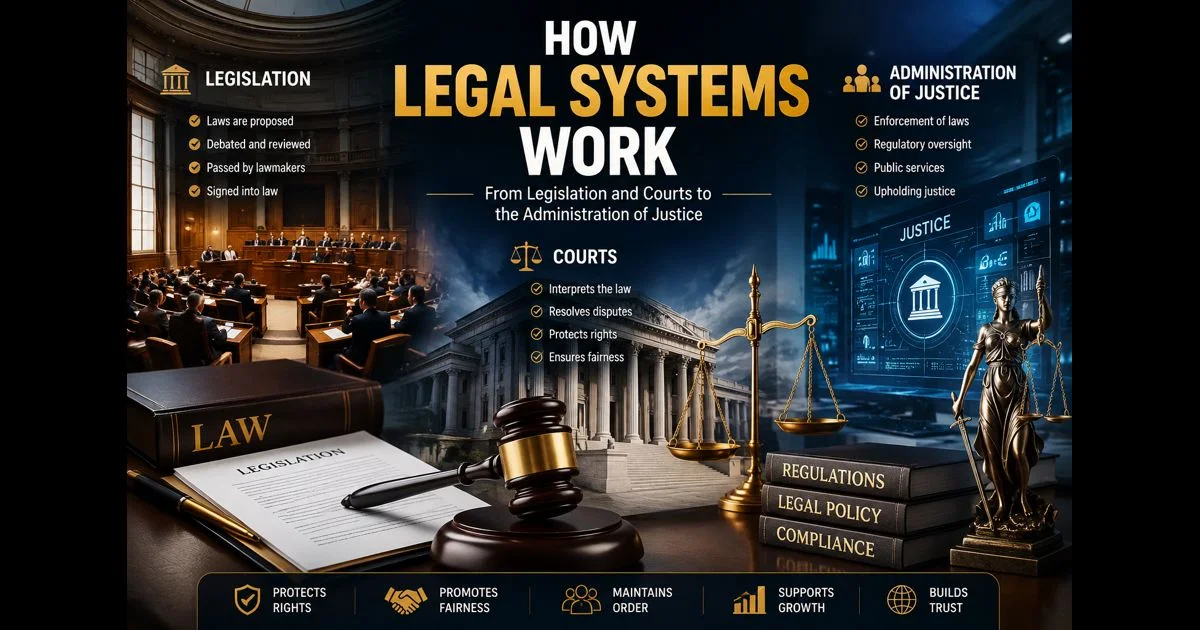
For broader context on institutions, legislation, and courts, see this guide on how legal systems work.
Courts, procuratorates, and dispute resolution
People’s courts hear civil, criminal, administrative, and certain other matters. China generally follows a two-instance final system: after a first-instance judgment, a party may usually appeal once to the next higher court. Certain supervisory and retrial procedures may also be available in defined circumstances, but they are not a routine substitute for an appeal.
The people’s procuratorates have a separate constitutional role. They supervise legal processes and exercise prosecutorial functions in criminal matters. Their role should not be confused with that of the courts or private lawyers.
Disputes are not always resolved through litigation. Parties may use negotiation, mediation, arbitration, or administrative channels, depending on the subject matter and the agreement between them. In cross-border commercial contracts, dispute-resolution clauses require particular care because the chosen forum, arbitration institution, language, governing law, and enforcement route can materially affect the outcome.
Commercial law and foreign business activity
Chinese law contains extensive rules relevant to companies, investors, manufacturers, technology businesses, and online platforms. Common areas include:
- Company establishment and corporate governance
- Contract formation and performance
- Intellectual-property registration and enforcement
- Employment and labour compliance
- Product quality and consumer protection
- Tax, customs, and foreign-exchange controls
- Competition and anti-monopoly compliance
- Data, cybersecurity, and personal-information protection
The answer to a business question rarely comes from one statute alone. A company entering a regulated market may need to examine its corporate form, licences, sector rules, product requirements, data flows, advertising, tax treatment, and local enforcement expectations.
Foreign investment is governed by a framework that includes the Foreign Investment Law and the national negative-list system. Where an industry appears on a negative list, foreign investment may be restricted or subject to conditions. Businesses should check the current version of applicable rules before taking action, because regulatory classifications and procedures can change.
Intellectual property in China
China’s intellectual-property framework includes trademark, patent, copyright, trade-secret, and unfair-competition protections. Registration is especially significant for many rights, particularly trademarks.
Businesses often underestimate the importance of early trademark filing. A brand may be exposed when it is used publicly before suitable registrations are pursued. Product names, Chinese-language versions of a name, logos, domain names, and distributor arrangements should be reviewed together rather than as isolated issues.
IP disputes can involve administrative enforcement, civil litigation, customs measures, or negotiation. The appropriate path depends on the right involved, evidence available, urgency, geographic scope, and the commercial objective.
Data protection, cybersecurity, and digital operations
Digital activity is a major area of Chinese law. Three foundational laws are frequently relevant:
- Cybersecurity Law
- Data Security Law
- Personal Information Protection Law
These frameworks address different but overlapping issues. Requirements may concern the collection and handling of personal information, data-security measures, important data, cross-border data transfers, network operations, consent, and the responsibilities of organisations that process data.
Businesses should avoid treating a privacy notice as the entire compliance exercise. The legal assessment may require a data map, clear allocation of responsibilities, retention rules, vendor controls, security safeguards, incident-response planning, and an analysis of whether data can be transferred outside China.
Regulatory requirements in this area continue to evolve. Official material and current implementing measures should be checked before a digital product, website, cloud service, or cross-border data workflow is launched.
Why legal translations require caution
An English translation can make Chinese legislation more accessible, but it may not be the authoritative text. Terminology can carry technical meanings that do not map perfectly into English. Amendments, implementing rules, local measures, and court interpretations can also change the practical meaning of a provision.
When accuracy is important, compare the Chinese original with a reliable translation, identify the date and status of the text, and confirm whether later measures affect it. Readers can use this site’s guide to researching and verifying legal information online to assess a source before relying on it.
A practical way to assess a Chinese-law issue
A careful starting review should identify:
- The jurisdiction involved: mainland China, Hong Kong, Macao, Taiwan, or more than one jurisdiction.
- The legal subject: contract, employment, company law, intellectual property, tax, data, competition, property, or another field.
- The authoritative source: legislation, regulation, court interpretation, regulator guidance, or a decision.
- The date: whether the source remains in force and whether amendments or transition rules apply.
- The facts: parties, location, industry, documents, deadlines, and conduct can all affect the legal analysis.
- The consequence of error: a high-value transaction, formal notice, enforcement risk, or litigation deadline warrants advice from a suitably qualified professional.
This method does not replace legal advice. It helps prevent the common mistake of applying a broad summary to facts that require a more precise legal assessment.
Frequently asked questions
Is Chinese law the same in Hong Kong and mainland China?
No. Mainland China applies the PRC legal system, while Hong Kong has a distinct common-law system. Macao and Taiwan also have separate legal systems.
Are court decisions binding precedent in China?
China is a statute-centred legal system. Court decisions do not operate exactly like common-law precedent, though Supreme People’s Court judicial interpretations, guiding cases, and adjudicative materials can be influential.
Where can readers verify Chinese legislation?
Start with official Chinese government, legislative, court, and regulatory sources. Confirm the original text, issue date, effective date, amendments, and the correct jurisdiction.
Can a general article determine the answer to a legal problem?
No. Legal outcomes can depend on documents, evidence, deadlines, industry rules, local practice, and the facts of the matter. Specific advice requires an appropriately qualified legal professional.
Final thoughts
Chinese law is best understood as a layered legal system in which written legislation, administrative regulation, judicial interpretation, and institutional practice interact. The most reliable approach is to identify the correct jurisdiction, read the current primary materials, and avoid drawing conclusions from a single translated extract or general summary.
For legal matters involving significant rights, commercial exposure, enforcement action, litigation, or regulatory obligations, timely advice from a qualified professional with relevant PRC-law experience is essential.