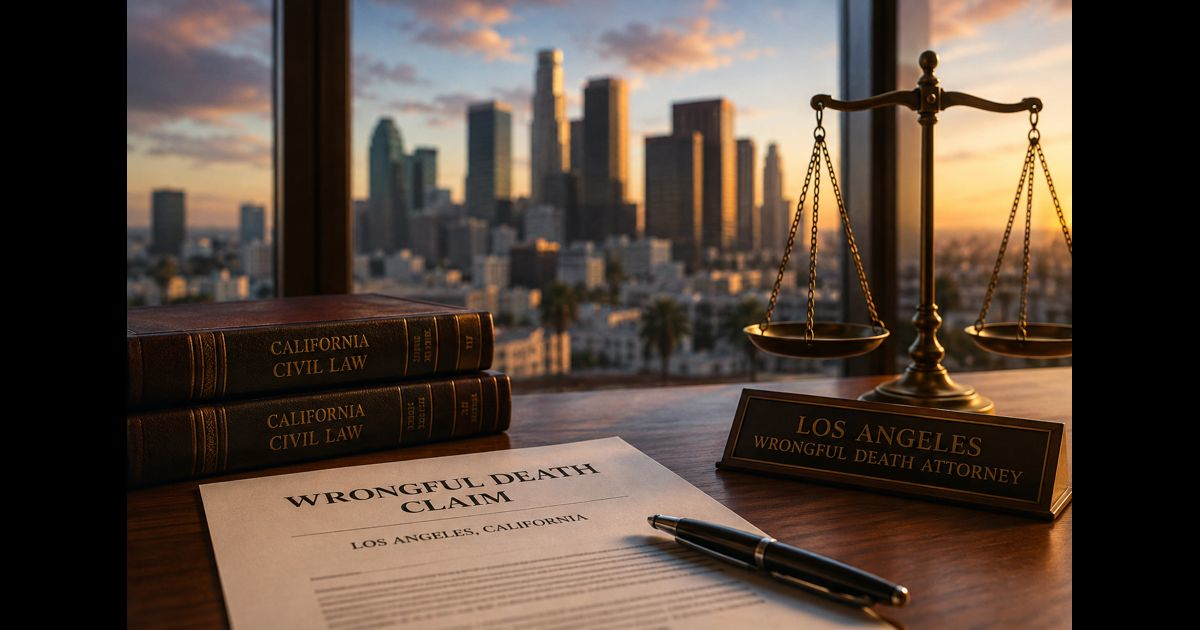
A Los Angeles wrongful death attorney handles civil claims arising when a person dies because of another party's wrongful act or negligence. California law gives specified surviving family members and, in appropriate circumstances, the decedent's personal representative the right to pursue a wrongful death action.
The claim is intended to compensate eligible survivors for losses resulting from the death. It is different from a criminal case and is also distinct from a survival action belonging to the deceased person's estate.
For families in Los Angeles, understanding those distinctions matters because eligibility, available damages, evidence, and filing deadlines can determine whether a claim can proceed.
When a Death Can Support a Wrongful Death Claim
A death does not become a wrongful death case merely because it was unexpected or preventable. There must be a legal basis for holding another person or entity responsible.
California Code of Civil Procedure Section 377.60 applies when a person's death is caused by the wrongful act or neglect of another. Depending on the circumstances, responsibility may arise from negligence, professional negligence, a dangerous product, unsafe property, or intentional misconduct.
A viable case generally requires evidence connecting the defendant's conduct to the death. That connection can become one of the most contested parts of a case when the deceased person had serious existing health conditions, several parties were involved, or the fatal consequences developed sometime after the original incident.
Common circumstances include:
- fatal car, truck, motorcycle, bicycle, and pedestrian collisions;
- medical negligence;
- dangerous or defective products;
- unsafe property conditions;
- workplace incidents involving a legally responsible third party; and
- intentional wrongful acts.
The underlying legal rules vary considerably between these situations. A fatal traffic collision, for example, raises different evidence and insurance issues from a death allegedly resulting from medical negligence.
Who Can File a Wrongful Death Lawsuit in California?
California does not allow every relative or person close to the deceased to bring a wrongful death action.
Under Code of Civil Procedure Section 377.60, eligible parties can include the deceased person's:
- surviving spouse;
- registered domestic partner;
- children;
- descendants of deceased children; and
- certain people who would inherit through California intestate succession when there is no surviving issue.
The statute also provides rights in specified circumstances to people who were financially dependent on the deceased, including a putative spouse, children of a putative spouse, stepchildren and parents.
A dependent minor can qualify under a separate provision when the minor lived in the deceased person's household for the preceding 180 days and depended on that person for at least half of the minor's support.
Eligibility therefore should not be assumed solely from the closeness of a relationship. Marriage, parentage, dependency, intestate succession and household circumstances can affect standing.
Multiple Heirs and the Single Wrongful Death Action
The presence of several eligible relatives can make a case more complicated.
California generally treats wrongful death as a single, joint cause of action. Eligible heirs cannot ordinarily divide the same death into a series of independent lawsuits simply because each survivor experienced a different loss.
That makes identifying all potential heirs important. Family relationships, previously unknown heirs, disputes over eligibility and disagreements about allocation can create issues that need to be addressed before a case is resolved.
Each eligible survivor's loss may nevertheless be different. A surviving spouse may have lost decades of expected financial support and companionship, while a minor child may have substantial losses involving support, care, training and guidance.
What Must Be Proven?
A wrongful death plaintiff still has to establish the legal responsibility underlying the death.
In an ordinary negligence case, the evidence typically must establish that the defendant owed a duty, failed to meet the required standard of care, caused the death, and produced legally compensable losses.
Causation deserves particular attention.
It may be relatively straightforward when a person dies immediately in a collision caused by a clearly negligent driver. It can become considerably more complex when several events occurred between the defendant's conduct and the death.
Medical records, collision evidence, photographs, video, witness testimony, electronic information, employment records and expert analysis may become relevant depending on the case.
The evidence needed to prove responsibility is not necessarily the same evidence needed to establish the value of the family's losses.
What Damages Are Available in a California Wrongful Death Case?
Wrongful death damages compensate eligible survivors for their own legally recognized losses caused by the death.
Economic damages can include:
- financial support the deceased would probably have contributed;
- loss of gifts or benefits the survivors could reasonably have expected;
- funeral and burial expenses; and
- the reasonable value of household services the deceased would have provided.
Non-economic damages can include the loss of the deceased person's love, companionship, comfort, care, assistance, protection, affection, society, moral support, training and guidance, depending on the survivor's relationship to the deceased.
California makes an important distinction between these losses and grief itself. The survivors' grief, sorrow and mental suffering are not separate elements of wrongful death damages.
That distinction can seem unusual because emotional loss is inseparable from a death in everyday life. Legally, however, the focus is on the value of the relationship and what the survivor has lost through the absence of the deceased person.
There Is No Standard Wrongful Death Settlement
There is no reliable "average" Los Angeles wrongful death settlement that can determine what another case is worth.
Two cases arising from similar accidents can have substantially different values.
Financial damages may depend on the deceased person's:
- age;
- earnings and employment history;
- expected career path;
- benefits;
- health;
- life expectancy;
- work-life expectancy; and
- financial contributions to the household.
The value of household services may also be significant. Childcare, transportation, cooking, maintenance and other work performed for a household have economic value even when the deceased person was not paid for performing those tasks.
Non-economic losses are similarly individual. The nature and duration of the relationship between the deceased and each eligible survivor matter more than a generic dollar figure assigned to a particular type of accident.
Liability can also affect the outcome. California's comparative-fault rules can reduce recovery when evidence establishes that the deceased person shared responsibility for the incident.
Wrongful Death and Survival Actions Are Different Claims
Wrongful death and survival actions are frequently confused, but they address different losses.
A wrongful death claim belongs to eligible survivors and compensates them for losses they personally sustain because of the death.
A survival action preserves certain claims that the deceased person could have pursued had the person survived. It is generally brought by the decedent's personal representative or successor in interest.
A survival action can include qualifying losses sustained by the deceased before death, such as medical expenses, lost earnings and property damage. Punitive or exemplary damages may also be available when the underlying facts and legal requirements support them.
The distinction is especially important in 2026.
California temporarily permitted recovery of a decedent's pre-death pain, suffering or disfigurement in qualifying survival actions filed on or after January 1, 2022 and before January 1, 2026. For actions filed on or after January 1, 2026, Code of Civil Procedure Section 377.34 again generally excludes those damages.
A family may have both a wrongful death claim and a survival action arising from the same event, but the damages belonging to the survivors should not be confused with damages belonging to the deceased person's estate.
Punitive Damages Require Separate Analysis
Punitive damages are not ordinarily part of the survivors' wrongful death damages.
They may potentially be pursued through a survival action when the deceased person would have been entitled to punitive damages had the person lived and the evidence satisfies California's requirements for such an award.
This can matter in cases involving conduct substantially more serious than ordinary negligence.
Because punitive damages depend on both the nature of the defendant's conduct and the procedural basis for pursuing the deceased person's claim, they should not simply be added to every wrongful death damages calculation.
How Long Do You Have to File a Wrongful Death Claim in California?
For many California wrongful death actions, the limitations period is two years.
Code of Civil Procedure Section 335.1 provides a two-year period for an action involving the death of an individual caused by another person's wrongful act or neglect.
The general two-year rule should not be treated as universal.
Different or additional deadlines can apply depending on the defendant and legal theory.
Claims involving public entities
When a claim involves a California public entity, the Government Claims Act can require a claim relating to death to be presented within six months after accrual.
That requirement can arise in matters involving governmental agencies or public employees and may apply well before the ordinary wrongful death limitations period would expire.
Medical negligence
Deaths allegedly caused by professional medical negligence are governed by additional California rules concerning medical malpractice claims. Their timing requirements should be evaluated separately rather than assuming the ordinary two-year deadline controls.
Because filing rules can depend on facts that are not immediately obvious, determining the applicable deadline is one of the issues that should be addressed early.
Medical Malpractice Wrongful Death Claims Have Special Damage Rules
California generally does not impose a universal cap on wrongful death damages arising from ordinary negligence. Professional medical negligence is an important exception.
California's MICRA framework limits non-economic damages in medical malpractice cases. For wrongful death cases subject to the current schedule, the applicable non-economic damages limit increases over time under the statutory framework.
Economic damages are treated differently from capped non-economic damages. Lost financial support and other provable economic losses can therefore be particularly important in a medical negligence death case.
Medical malpractice cases also frequently require specialized evidence concerning the professional standard of care and whether the alleged negligence actually caused the patient's death.
Evidence That Can Affect a Wrongful Death Case
Strong cases depend on evidence rather than the seriousness of the loss alone.
Evidence concerning responsibility can include:
- police or incident reports;
- photographs and video;
- vehicle or equipment data;
- medical records;
- autopsy and coroner records;
- witness accounts;
- business records;
- safety and maintenance records;
- electronic communications; and
- testimony from qualified experts.
Evidence concerning damages can require a different set of records, including tax returns, earnings history, employment benefits, retirement information and documentation showing the deceased person's contributions to the household.
Evidence can disappear with time. Video may be overwritten, physical conditions can change, vehicles can be repaired or destroyed, and witnesses' memories can become less precise. Preservation can therefore matter even when a lawsuit is not immediately filed.
How a Los Angeles Wrongful Death Attorney Evaluates a Case
A careful evaluation should begin with the facts rather than an assumed settlement value.
The attorney needs to determine who may legally bring the action, which parties may be responsible, what evidence establishes causation, what insurance or other sources of recovery exist, and which deadlines apply.
The work can include:
- identifying every potentially responsible party;
- preserving evidence before it disappears;
- obtaining medical, collision, employment and other relevant records;
- determining the eligible wrongful death claimants;
- examining whether a survival action also exists;
- evaluating available insurance and other sources of recovery;
- consulting appropriate experts when specialized issues are disputed;
- calculating economic and non-economic losses;
- negotiating supported claims rather than relying on arbitrary settlement figures; and
- preparing the case for litigation when liability or damages cannot be resolved.
Not every case requires the same investigation. The appropriate work depends on how the death occurred and what issues the evidence leaves disputed.
Choosing a Los Angeles Wrongful Death Attorney
Wrongful death cases require more than general familiarity with personal injury claims.
A useful evaluation should consider whether an attorney has meaningful experience with the particular type of fatal incident involved. A medical negligence case, commercial trucking death, defective-product claim and ordinary automobile collision can require substantially different evidence and expert testimony.
Families can ask prospective attorneys:
- Who will actually handle the case?
- Has the attorney handled comparable wrongful death matters?
- How will potential defendants be identified?
- How are experts selected and paid?
- How are litigation expenses handled?
- What contingency fee applies?
- What happens to case costs if there is no recovery?
- How will major settlement decisions be communicated?
- How will multiple eligible heirs be handled?
- Is a survival action potentially available?
- Is the attorney prepared to litigate if settlement negotiations fail?
A large advertised verdict or settlement does not establish what another family's case will produce. Relevant experience, factual preparation, communication and a clear explanation of fees provide more useful information.
What Families Should Avoid After a Fatal Incident
Several early decisions can affect a later claim.
Avoid signing a broad release before understanding which claims it resolves. A quick insurance payment can be inadequate when the full financial consequences of a death have not yet been calculated.
Important physical and electronic evidence should not be discarded. Photographs, messages, videos, documents, damaged property and other materials connected to the incident may later become important.
Public statements also deserve caution. Posts about the incident, the deceased person's activities or ongoing litigation can become evidence.
Most importantly, do not assume that an insurance company's assessment establishes either legal responsibility or the value of the case. Insurers evaluate claims from their own contractual and financial position.
Frequently Asked Questions
What does a Los Angeles wrongful death attorney do?
A wrongful death attorney investigates the circumstances of a death, identifies potentially responsible parties and eligible claimants, preserves evidence, evaluates damages, deals with insurers and opposing parties, and pursues the civil claim through settlement or litigation when appropriate.
Who can sue for wrongful death in Los Angeles?
California Code of Civil Procedure Section 377.60 gives standing to specified people, including a surviving spouse or registered domestic partner, children and certain other heirs. Financially dependent parents, stepchildren and other specified dependents can qualify in particular circumstances.
Is there a two-year deadline for wrongful death in California?
Two years is the general limitations period for many actions involving a death caused by another person's wrongful act or neglect. Shorter or different rules can apply, particularly to claims involving public entities or professional medical negligence.
What can a family recover?
Potential damages include lost financial support, lost household services, funeral and burial expenses, and qualifying non-economic losses involving companionship, care, comfort, protection, guidance and similar aspects of the relationship.
Can survivors recover damages for their grief?
California wrongful death damages do not separately compensate survivors for their grief, sorrow or mental suffering. The law instead permits recovery for specified losses resulting from the relationship with the deceased, including loss of companionship, care and moral support.
Are wrongful death damages capped in California?
Most ordinary California wrongful death cases do not have a general cap on non-economic damages. Different rules apply to wrongful deaths caused by professional medical negligence, where MICRA limits can apply.
Is a survival action the same as wrongful death?
No. Wrongful death compensates eligible survivors for their own losses. A survival action continues qualifying claims belonging to the deceased person and is pursued on behalf of the estate by the appropriate representative or successor in interest.
Can a survival action recover pre-death pain and suffering in 2026?
For a standard survival action filed on or after January 1, 2026, California Code of Civil Procedure Section 377.34 generally does not permit damages for the deceased person's pain, suffering or disfigurement. A temporary provision applied to qualifying actions filed from January 1, 2022 through December 31, 2025.
Can several relatives file separate wrongful death lawsuits?
Eligible heirs generally participate in a single wrongful death action rather than maintaining separate lawsuits arising from the same death. Identifying all eligible heirs is therefore an important part of handling the claim.
Does a criminal case prevent a wrongful death lawsuit?
No. Criminal proceedings and wrongful death actions serve different purposes and use different legal standards. A civil wrongful death claim may exist regardless of whether criminal charges are filed or result in a conviction.
Final Thoughts
A Los Angeles wrongful death claim involves more than proving that a death occurred after another person's mistake. California law determines who has standing to sue, the losses that can be compensated, the relationship between wrongful death and survival claims, and the time available to preserve legal rights.
The most important issues are often specific to the individual case: what caused the death, who is legally responsible, which family members qualify, what evidence remains available, what financial and relational losses can be established, and whether an ordinary or shortened deadline applies.
Those questions should be resolved from the evidence and the current California statutes rather than from generalized settlement estimates or assumptions about how another wrongful death case was handled.