Legal systems turn broad ideas about order, fairness, responsibility, and public authority into rules that can be applied in real situations. They determine who may create laws, how those laws take effect, which institutions interpret them, what procedures courts must follow, and how legal decisions are enforced or reviewed.
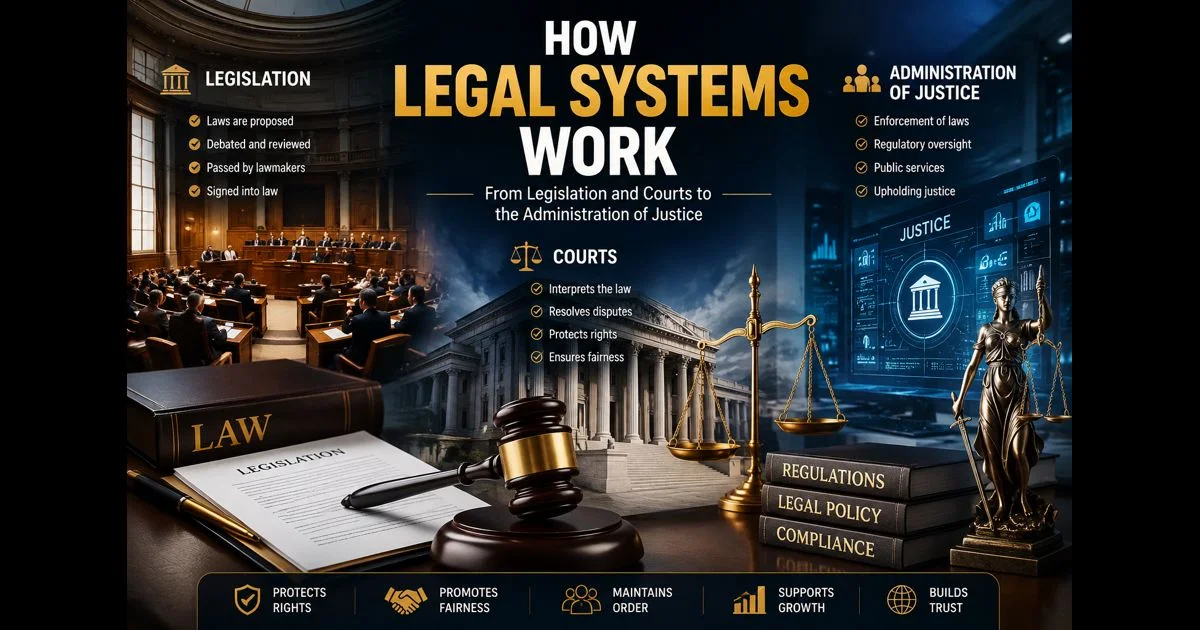
No single institution performs all of these functions. Legislatures create statutes, executive bodies administer them, regulators develop detailed requirements, courts resolve disputes, and enforcement authorities carry lawful decisions into effect. Constitutions or other foundational rules define the powers and limits of these institutions. The result is an interconnected framework rather than a collection of isolated laws.
The exact structure differs between countries and sometimes between states, provinces, or territories within the same country. Even so, most functioning legal systems must answer the same basic questions: Where does legal authority come from? Who makes and interprets the law? How are facts established? What happens when a decision is challenged? And how are rights protected while public rules are enforced?
A Legal System Is More Than Written Law
Written legislation is only one part of a legal system. A statute may establish a right, duty, prohibition, or public program, but institutions and procedures are needed to give that text practical effect. A court may have to clarify an unclear provision. A regulator may need to issue detailed rules. An administrative body may decide whether an applicant qualifies for a licence or benefit. An enforcement agency may be responsible for responding to a violation.
This is why the law found in a statute book does not always provide a complete answer to a legal question. The applicable constitution, regulations, judicial decisions, procedural rules, and jurisdiction may all matter. Dates are important as well: a law may have been enacted but not yet brought into force, amended after publication, or interpreted by a later court decision.
A reliable understanding of a legal issue therefore begins by identifying both the governing rule and the institution responsible for applying it.
Where Legal Authority Comes From
Legal systems use a hierarchy of authority. Rules lower in that hierarchy generally must be consistent with rules above them, although the terminology and review process vary by jurisdiction.
Constitutions and Foundational Law
A constitution commonly establishes the structure of government, distributes public power, and sets limits on how that power may be exercised. It may also protect fundamental rights and define the relationship between national and regional institutions.
Where a written constitution is treated as the highest form of domestic law, legislation or government action that conflicts with it may be challenged through an authorized review process. Other jurisdictions rely on a combination of statutes, conventions, judicial principles, and historic instruments rather than one codified constitutional document.
Legislation
Legislation consists of laws formally adopted by a body with law-making authority. Depending on the jurisdiction, these may be called acts, statutes, codes, ordinances, or laws. Legislation can address broad areas such as criminal conduct, contracts, employment, taxation, property, consumer protection, data use, and public administration.
A statute normally states its scope, important definitions, the duties or powers it creates, and any remedies or penalties connected to non-compliance. Its effect may still depend on regulations, commencement provisions, or later judicial interpretation.
Regulations and Delegated Rules
Legislatures often establish a general framework and authorize a ministry, department, regulator, or other public body to create more detailed rules. These rules may specify technical standards, filing procedures, licensing conditions, reporting obligations, or compliance requirements.
Because delegated rules derive their authority from legislation, the issuing body must remain within the power granted to it. A rule may be open to challenge if the body exceeded its authority, ignored a required procedure, or acted inconsistently with superior law.
Judicial Decisions
Courts interpret legal texts and apply them to specific facts. In common-law systems, decisions from higher courts may bind lower courts on the same legal issue. In civil-law systems, comprehensive codes and enacted legislation generally occupy a more central formal role, although judicial decisions still contribute to consistent interpretation.
This distinction should not be treated as absolute. Modern systems often combine features from different traditions, and the weight given to earlier decisions depends on the court, the issue, and the jurisdiction.
Customary, Religious, and International Sources
Some jurisdictions recognize customary or religious law in particular areas or communities. International treaties may also create obligations between states and can influence domestic law. Whether a treaty applies directly within national courts or requires implementing legislation depends on the constitutional system concerned.
These additional sources show why legal rules cannot safely be assumed to operate in the same way everywhere.
How a Proposal Becomes Enforceable Law
Although legislative procedures vary, a proposal usually passes through several stages before it can be enforced.
Identifying and Drafting a Proposal
A proposal may respond to a social problem, a court decision, a policy commitment, technological change, an international obligation, or a weakness in existing law. Legal drafters then translate the intended policy into language that defines its scope and effect.
Good drafting matters because vague definitions, conflicting provisions, or unclear powers can create uncertainty. Legislators must consider not only what a proposal is meant to achieve but also how people, courts, regulators, and public bodies will apply it.
Scrutiny, Debate, and Amendment
Proposed legislation is normally reviewed according to the procedures of the relevant legislature. This may involve committee examination, public consultation, expert evidence, debate, and amendments. Scrutiny can reveal unintended consequences, implementation costs, conflicts with existing law, or concerns about protected rights.
The process does not guarantee a perfect result, but it creates a formal record of consideration and allows the proposal to be refined before adoption.
Approval, Publication, and Commencement
Once the required approvals have been obtained, the law is formally enacted and published. Enactment does not always mean immediate application. A commencement clause may specify a future date or authorize the government to bring different provisions into force at different times.
This interval can give courts, regulators, businesses, and the public time to prepare. Supporting regulations, official forms, administrative systems, or staff training may also be required before the law can operate effectively.
How Courts Turn General Rules Into Decisions
Legislation is usually written in general terms, while disputes arise from specific events. Courts connect the two by establishing the relevant facts, identifying the governing law, hearing the parties, and giving a reasoned decision.
Jurisdiction Comes First
Before deciding the substance of a case, a court must have authority to hear it. Jurisdiction may depend on location, subject matter, the parties, the amount in dispute, or the type of remedy requested. Filing in the wrong court can cause delay, transfer, or dismissal without resolving the underlying issue.
Courts also apply procedural rules governing time limits, documents, notice, evidence, and hearings. These requirements are not mere formalities; they help ensure that each side understands the case and has a fair opportunity to respond.
The Court Establishes the Facts
Parties may disagree about both what happened and what the law means. Courts assess admissible material such as documents, witness evidence, expert evidence, agreed facts, and physical or digital records. The applicable standard of proof determines how convincingly a factual claim must be established.
The burden and standard of proof are not identical in every proceeding. Criminal cases commonly require the prosecution to prove guilt to a higher standard than the standard generally used to decide civil claims. Precise formulations vary by jurisdiction.
The Court Identifies and Interprets the Law
Once the relevant facts are established, the court determines which legal rules apply. A judge may consider the wording and structure of a statute, its purpose, related provisions, constitutional requirements, applicable precedent, and recognized principles of interpretation.
Courts do not ordinarily rewrite legislation simply because another policy might appear preferable. Their institutional task is to interpret and apply the law within the authority assigned to them. Where a constitutional system permits judicial review, a court may also examine whether legislation or government action complies with superior law.
The Court Gives a Decision and Remedy
A reasoned judgment explains the material facts, legal issues, applicable rules, and conclusion. In a civil matter, the remedy may include compensation, an injunction, a declaration, restitution, or an order requiring a contractual obligation to be performed. In a criminal matter, a conviction may be followed by a sentence authorized by law.
Winning a case and enforcing a judgment are not always the same step. A successful party may still need to use a lawful enforcement process to recover money or secure compliance with an order.
Civil, Criminal, and Administrative Proceedings
Different types of proceedings serve different purposes and follow different rules.
Civil Proceedings
Civil cases usually concern disputes between individuals, organizations, or sometimes public bodies. Common subjects include contracts, property, negligence, employment, family matters, and commercial obligations. The claimant seeks a legal remedy rather than a criminal conviction.
Many civil disputes end through negotiation, mediation, arbitration, withdrawal, or settlement. A court judgment is therefore one possible outcome within a wider dispute-resolution system.
Criminal Proceedings
Criminal law addresses conduct defined by law as an offence. Public authorities investigate suspected offences, and an authorized prosecuting body decides whether charges should proceed under the applicable rules. The court then determines the case through procedures intended to protect the public interest and the rights of the accused.
The presumption of innocence, access to a defence, impartial adjudication, and strict control over evidence are central safeguards in many criminal justice systems. Their detailed operation depends on local law.
Administrative Proceedings
Administrative law governs decisions made by public agencies and officials. These decisions may involve licences, immigration status, taxation, public benefits, professional discipline, planning permission, or regulatory enforcement.
An affected person may be entitled to an internal review, a specialist tribunal hearing, or judicial review by a court. Judicial review generally examines the lawfulness of the decision-making process rather than asking the court to substitute its preferred policy outcome.
Appeals and Judicial Review Are Different Safeguards
An appeal asks a higher court or authorized body to review a decision on grounds permitted by law. It is not automatically a complete retrial. The reviewing body may focus on a legal error, a procedural failure, an unsupported factual conclusion, or another recognized ground. It may affirm the decision, vary it, set it aside, or return the matter for reconsideration.
Judicial review has a different function. It usually examines whether a public authority acted lawfully, followed a fair procedure, used its powers for a proper purpose, and remained within the limits of its authority. The reviewing court is generally concerned with legality rather than the merits of the policy choice itself.
Both mechanisms promote accountability, but neither is available without limits. Permission requirements, filing deadlines, standing rules, and restrictions on the issues that may be raised can affect whether review is possible.
Institutions That Support the Administration of Justice
Courts depend on a wider network of institutions. Legislatures maintain the statutory framework. Government departments and regulators administer public programs and oversee compliance. Police and investigative bodies gather evidence under legal authority. Prosecutors assess criminal cases. Lawyers advise and represent parties. Court staff manage filings, records, schedules, and hearings.
Mediators and arbitrators also help resolve disputes outside ordinary court proceedings. Ombuds offices, inspectors, auditors, ethics bodies, and professional regulators may investigate complaints or oversee institutional conduct.
Each body has a distinct mandate. Problems arise when an institution exceeds that mandate, lacks independence, applies rules inconsistently, or becomes inaccessible to the people it is meant to serve.
Principles That Make Legal Authority Legitimate
A legal system cannot earn confidence through enforcement alone. People must have reason to believe that authority is exercised according to known rules and fair procedures.
The rule of law requires public power to have a legal basis and places government institutions within the legal framework. Judicial independence protects judges from improper influence. Procedural fairness gives affected people notice of a case and a meaningful opportunity to respond. Open hearings and reasoned decisions support transparency, subject to lawful limits needed to protect privacy, safety, or vulnerable participants.
Equal protection and consistent treatment are also essential, but formal rules mean little if people cannot use them. Cost, delay, language barriers, geographic distance, disability, and lack of legal assistance can all restrict practical access to justice. Courts and policymakers must therefore consider both the existence of legal rights and the ability to exercise them. A related guide explains how legal rights and responsibilities affect ordinary decisions outside the courtroom.
Why Legal Systems Differ Across Jurisdictions
There is no single worldwide court structure or legislative process. Legal systems develop from different constitutional arrangements, histories, political structures, and legal traditions. A rule that applies nationally in one country may be controlled by a state or province in another. A higher-court decision may be binding in one system and only persuasive in another.
Terminology can also mislead. Words such as appeal, regulation, tribunal, prosecutor, or constitutional review may describe different powers and procedures in different places. Even when two jurisdictions use the same legal phrase, its statutory definition may differ.
For this reason, general legal information should be used to understand concepts, not to assume a particular outcome. The correct jurisdiction, current date, controlling authority, and procedural posture must be identified before a legal source can be applied responsibly.
Technology Is Changing Administration, Not Core Safeguards
Electronic filing, online case tracking, remote hearings, searchable judgments, and digital evidence systems can make justice more accessible and efficient. Technology can also assist with scheduling, document review, translation, legal research, and routine administrative work.
These benefits introduce risks involving privacy, cybersecurity, unequal digital access, unreliable automation, and limited transparency. A tool used to support legal work does not carry judicial authority of its own. Decisions affecting liberty, rights, or legal responsibility still require authorized human judgment, a lawful process, and a meaningful opportunity to challenge error.
Digital access also increases the amount of unofficial, outdated, or jurisdictionally irrelevant material available to readers. Anyone relying on online sources should know how to research and verify legal information online before treating a summary as an accurate statement of current law.
A Practical Way to Understand Any Legal Process
When examining a legal issue, start with five questions:
- Which jurisdiction governs? Identify the country and, where relevant, the state, province, territory, or local authority.
- What type of matter is involved? Determine whether the issue is civil, criminal, administrative, constitutional, or governed by a specialist process.
- Which authority controls? Look for the constitution, statute, regulation, binding decision, or procedural rule that applies.
- Which institution has responsibility? Identify the court, tribunal, regulator, public agency, or other authorized body.
- What is the current procedural stage? A proposed law, filed claim, interim order, trial judgment, appeal, and enforced judgment have different legal significance.
This framework helps separate the existence of a legal rule from its interpretation, application, and enforcement. It also reduces the risk of treating an allegation as a proven fact, a lower-court ruling as a final outcome, or a proposed bill as current law.
Final Thoughts
Legal systems work through the coordinated exercise of limited authority. Legislatures create general rules, executive and regulatory bodies administer them, courts interpret and apply them, and review mechanisms help correct legal or procedural error. Supporting institutions make those decisions practical through investigation, representation, recordkeeping, dispute resolution, and lawful enforcement.
Understanding these relationships is more useful than memorizing isolated legal terms. It allows readers to distinguish a statute from a regulation, a trial decision from an appeal, and a policy choice from a question of legality. Most importantly, it shows why jurisdiction, procedure, evidence, institutional authority, and access to justice all matter when law moves from written text to real-world effect.
This article provides general legal education and does not offer advice for a specific case or jurisdiction. Anyone facing a legal deadline, dispute, charge, or decision affecting important rights should consult an appropriately qualified professional in the relevant jurisdiction.